FMCSA Clearinghouse Identity Verification: What It Means for Your Operation
FMCSA has rolled out enhanced identity verification inside the Drug and Alcohol Clearinghouse. If you have access to that system — as an employer, a third-party administrator, a Medical Review Officer, or a Substance Abuse Professional — the way you log in, run queries, and report violations is changing.
Not sure who has access to your Clearinghouse account?
Schedule a Mock DOT Audit
Drug & Alcohol Testing Programs
What FMCSA Announced
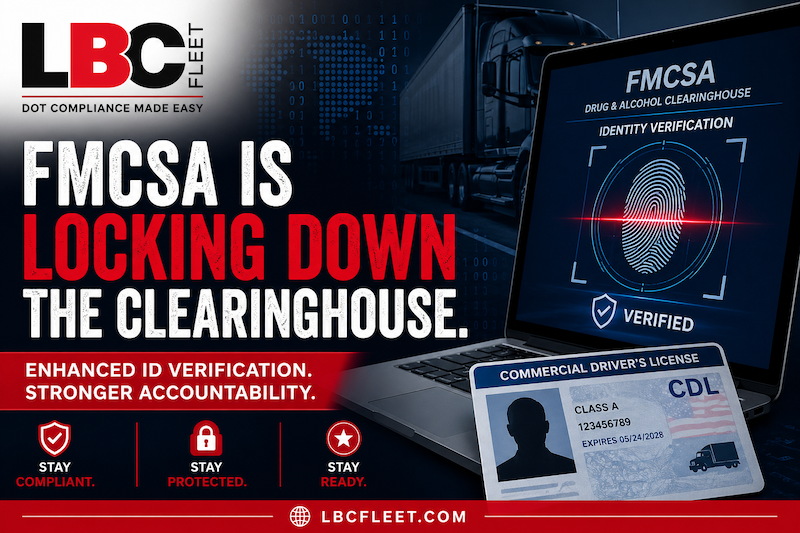
FMCSA is implementing enhanced identity verification through IDEMIA — the same platform used by TSA. The rollout starts with new registrations for employers, Medical Review Officers, Consortium/Third-Party Administrators (C/TPAs), and Substance Abuse Professionals. FMCSA has stated the same standards will then be applied to existing accounts for those same user groups.
If you are in the system, you will be verified.
Who This Applies To
This update is directed at users of the system, not at drivers as a class:
- Employers
- Third-party administrators and consortiums (C/TPAs)
- Medical Review Officers (MROs)
- Substance Abuse Professionals (SAPs)
Drivers are not the primary focus of this rollout, but their records are tied directly to the actions taken inside the system. If a violation is reported, cleared, or mishandled, it follows the driver.
Why This Is Being Implemented
FMCSA has stated zero tolerance for fraud inside the Drug and Alcohol Clearinghouse. That position comes after the system has grown to more than 6 million users. At that scale, access control and identity verification become part of enforcement, not just administration.
“Safety is non-negotiable at FMCSA, and that means ensuring the systems we rely on are secure, accurate, and trustworthy. By strengthening identity verification, we are closing gaps that could be exploited by bad actors, protecting the integrity of the data, and reinforcing confidence across the entire commercial driver safety industry.”
— Derek Barrs, FMCSA Administrator
There have been ongoing issues across the industry involving:
- Individuals presenting themselves as qualified Substance Abuse Professionals without proper credentials
- Drivers being moved through return-to-duty processes without legitimate evaluation
- Shared or loosely controlled account access within companies and third-party providers
- Inconsistent handling of Clearinghouse records tied to driver activity
Enhanced identity verification is designed to tie each action in the system to a verified individual.
How This Affects Drivers
Drivers are not being targeted for identity verification in the same way as employers or service providers. However, their Clearinghouse record is directly affected by what happens inside the system.
If a violation is entered, it stays attached to the driver. If a return-to-duty process is completed incorrectly, that record is still tied to the driver. As FMCSA increases control over system access, the accuracy and accountability of those records becomes more important.
What This Changes for Employers
The Clearinghouse is often treated as a periodic task: run pre-employment queries, complete annual queries, maintain records. With identity verification in place, the focus shifts to control over the account itself.
Employers need to know:
- Who has login access
- Who is running queries
- Who is responsible for reporting and managing violations
If a third party is handling the Clearinghouse on your behalf, their activity is still connected to your account.
Access and Accountability
Each action taken inside the Drug and Alcohol Clearinghouse will now be tied to a verified identity. This includes:
- Query submissions
- Violation reporting
- Return-to-duty documentation
Loose access, shared logins, or unclear responsibility creates risk when activity inside the system is reviewed.
Industry Direction
This update does not introduce a new rule. It strengthens how existing requirements are tracked and enforced.
The pattern is consistent across FMCSA right now — the Clearinghouse, the Unified Registration System, and the forthcoming Motus platform are all moving toward the same standard: one verified identity, tied to every action inside the system. Operations that already run tight access controls will absorb this with minimal disruption. Operations relying on shared logins or unclear ownership will feel it.
Frequently Asked Questions
Do drivers need to complete identity verification?
Not in the same way as employers and service providers at this time.
Will existing accounts be affected?
Yes. FMCSA has stated that enhanced verification will extend beyond new registrations to existing accounts within the same user groups.
What should employers review right now?
Account access, user roles, and how Clearinghouse activity is being managed internally or through third parties.
If you’re not clear on who is managing your Clearinghouse account, start there. LBC Fleet helps motor carriers tighten access, audit-proof their compliance programs, and run clean drug & alcohol testing operations.
Schedule a Mock DOT Audit
Drug & Alcohol Testing Programs
DOT Compliance Resource Hub