
Mandatory FMCSA Audit · First 18 Months
New Entrant Safety Audit Preparation
Every new interstate carrier faces a mandatory safety audit early in its first year on the road. It is pass or fail — there is no Conditional rating to fall back on, and a single acute violation can put you out of service. Our new entrant safety audit preparation gets your programs, documentation, and team ready so you clear it the first time. Built on the audit experience behind 3,000+ real DOT audits since 2015.
We start with a short scoping call, then build your documentation and coach your team. Most engagements run about 5 hours.

Why it's different
Pass or fail. No middle ground.
A compliance review can hand you a Conditional rating and time to fix it. A new entrant audit doesn't. Acute violations mean an immediate out-of-service order — so readiness on audit day is everything.
Real method
Built from real audits
Our prep comes from 3,000+ real DOT audits since 2015. We prepare you for what auditors actually pull and ask — not a generic checklist.
Efficient
About 5 hours, $150/hour
Most new entrant engagements run roughly 5 hours — a typical total around $750. Complete file prep, program setup, and audit-day coaching.
On this page
Jump to what you need.
Free resource
New Entrant Audit Checklist
The documentation checklist we use to prep new carriers — every program and file an auditor will ask for.
Why carriers choose LBC Fleet for new entrant safety audit preparation
- 500+ new entrant audits prepared, 99.8% pass rate. The number is the number.
- The real-audit foundation. Our method comes from 3,000+ real DOT audits since 2015 — we know what auditors pull and where new carriers get caught.
- Programs, not just paperwork. Drug and alcohol, DQ files, hours of service, maintenance, and safety management built from the ground up.
- Acute-violation focus. We close the gaps that cause automatic failure before audit day, not after.
- Audit-day coaching. Your team practices the questions and the document hand-off so nobody is improvising.
Not facing a scheduled audit yet? A proactive mock DOT audit services engagement is the broader starting point — it finds gaps across your whole operation before any notice arrives.
Our approach
Treat it as the checkpoint it is — and clear it cleanly
FMCSA designed the new entrant audit as an educational checkpoint. We respect that: we explain the why behind each requirement so your systems hold up long after the audit. But we also prepare you to pass on the first attempt, because the consequences of failure are real.
New to the whole process? Start with what happens in a DOT audit for the plain-language walkthrough.
What a new entrant safety audit examines
The audit checks that your safety management systems exist and function. Every area below is documentation we build and verify before audit day:
- Drug & alcohol program. Written policy, random consortium enrollment, pre-employment testing, and Clearinghouse compliance — see DOT drug testing services.
- Driver qualification files. Complete files per 49 CFR 391.51 for every driver. Ongoing help: outsourced DQ file management.
- Hours of service. ELD setup, driver training, and supporting-document procedures.
- Vehicle maintenance. DVIR process, preventive-maintenance schedules, and annual inspections.
- Insurance & operating authority. Required coverage, MCS-90 endorsements, current MCS-150, and active authority.
- Safety management controls. Written policies, training records, and corrective-action procedures.
- Clearinghouse registration. Employer and driver accounts with required queries — see the FMCSA Drug & Alcohol Clearinghouse.
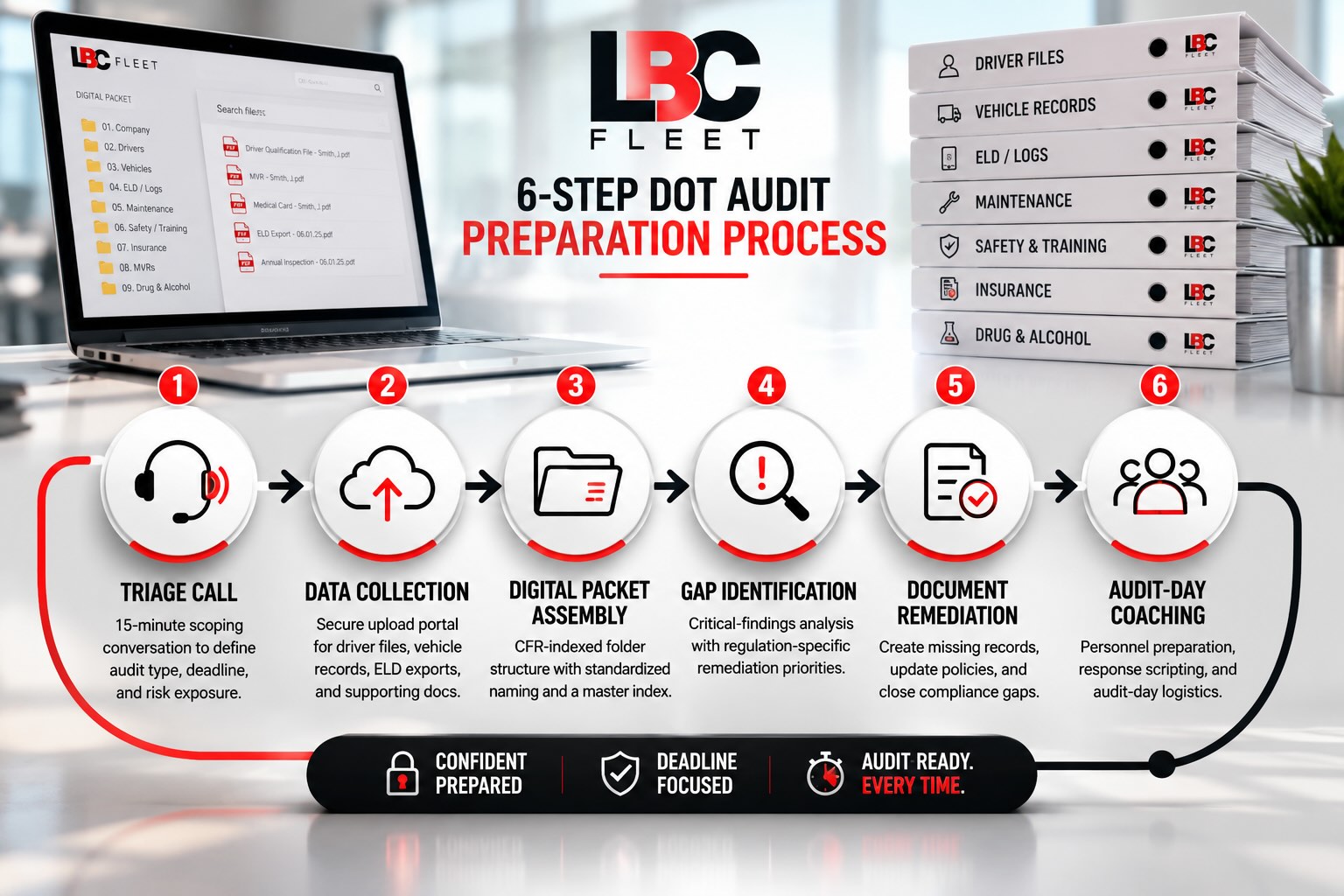
An educational audit with real consequences
FMCSA designed the new entrant safety audit to help new carriers learn the rules and build safety management systems. It does not assign a safety rating — there is no Satisfactory, Conditional, or Unsatisfactory at the end. In that sense it is genuinely educational.
That framing leads some operators to underprepare. The consequences are not educational. Acute violations trigger an immediate out-of-service order, and inadequate documentation can revoke your operating authority. There is no Conditional cushion to buy you time — you either demonstrate working systems or you face a corrective-action window and possible shutdown.
The audit usually comes within your first year of operation, sooner for passenger and hazmat carriers, with 10 to 30 days of advance notice. New entrant monitoring runs a full 18 months.
The distinction that matters
No rating ≠ no risk
A regular compliance review can downgrade you to Conditional and give you time to recover. A new entrant audit can't downgrade you — there's no rating to downgrade. What it can do is end your authority. That is why "educational" never means "low stakes" here.
Already past the audit and carrying a downgrade from a later review? That's the DOT safety rating upgrade path.
Violations that automatically fail a new entrant audit
These are acute violations. A single instance is enough to fail the audit and trigger corrective action or an out-of-service order. Our prep targets every one of them.
Drug & alcohol
- No alcohol or drug testing program
- No random testing program
- Using a driver who refused a test
- Using a driver with a BAC of 0.04 or greater
- Missing Clearinghouse queries
Driver
- Using a driver with no valid CDL
- Using a disqualified driver
- Using a driver with a revoked or suspended CDL
- Using a medically unqualified driver
- Missing driver qualification files
Operational
- Operating without required insurance
- No hours-of-service records
- Operating a vehicle declared out of service
- Skipping out-of-service repairs from DVIRs
- Operating a vehicle with no annual inspection
If you've already failed and are inside the corrective-action window, you need reactive help fast — see DOT audit preparation services. We triage what's fixable in the window and build your corrective action plan.
Our new entrant audit preparation process
Step 1
Assessment & gap analysis
- Review your current systems against new entrant requirements
- Identify the acute-violation gaps first
- Map your audit timeline and notice date
Step 2
Program build & documentation
- Stand up drug & alcohol, DQ, HOS, and maintenance programs
- Assemble audit-ready files organized for the auditor
- Close every gap from the assessment
Step 3
Mock run & coaching
- Practice the auditor's questions and document hand-off
- Confirm systems function, not just exist
- Support through your 18-month monitoring period
Pricing
$150 per hour — typically about $750
New entrant preparation is billed at $150 per hour. Most engagements take roughly 5 hours of work, putting the typical total around $750. That includes file preparation, program setup guidance, the mock run, and audit-day coaching. Nationwide, remote-first, onsite when needed.
We build your programs, assemble the documentation, and coach your team so audit day is a confirmation, not a gamble. Already failed? We handle corrective action plans too.
New entrant safety audit FAQ
What makes a new entrant audit different from a regular compliance review?
A new entrant audit is educational in purpose and does not assign a safety rating. A compliance review grades you Satisfactory, Conditional, or Unsatisfactory. The catch: a new entrant audit can't give you a Conditional cushion, so acute violations lead straight to corrective action or an out-of-service order.
When will my new entrant audit be scheduled?
It usually happens within your first year of operation, and sooner for passenger and hazmat carriers. You'll typically get 10 to 30 days of advance notice, and the audit can be conducted on-site or off-site depending on FMCSA's determination.
What violations automatically fail a new entrant audit?
Automatic failures include having no drug and alcohol testing program, no random testing program, using drivers without a valid CDL or who are disqualified, operating without required insurance, having no hours-of-service records, and operating a vehicle declared out of service.
Do I need Clearinghouse compliance for a new entrant audit?
Yes. Every employer with CDL drivers must be registered in the FMCSA Drug & Alcohol Clearinghouse and run the required queries. Missing Clearinghouse compliance is an automatic failure.
What happens if I fail my new entrant audit?
You'll have 45 to 60 days to implement a corrective action plan that fixes every deficiency. If the issues aren't corrected in that window, FMCSA can revoke your operating authority and place you out of service. There's no Conditional status to fall back on.
How long does new entrant status last?
New entrant monitoring lasts 18 months from when you receive your USDOT number. FMCSA watches your safety performance through roadside inspections and data during that window. Clear it, and you move to permanent operating authority.
How much does new entrant safety audit preparation cost?
Preparation is billed at $150 per hour. Most new entrant engagements take about 5 hours, so the typical total is around $750. That covers file preparation, program setup, a mock run, and audit-day coaching.
Do new entrant audits result in a safety rating?
No. New entrant audits don't produce a Satisfactory, Conditional, or Unsatisfactory rating — the purpose is to confirm your safety systems work. Failure can still lead to an out-of-service order. After your 18-month period, you may face a regular compliance review that does assign a rating.
Related resources
No notice yet
Mock DOT audit services
Proactive simulation that finds gaps across your whole operation before FMCSA does.
Notice in hand
DOT audit preparation services
Reactive prep for carriers already inside an audit or corrective-action window.
Rating came in low
DOT safety rating upgrade
Corrective action plans that move Conditional or Unsatisfactory back to Satisfactory.