
IFTA Audit Preparation Services for Carriers
IFTA audit preparation for interstate motor carriers — from the team behind 3,000+ real DOT audits since 2015. We reconcile your distance and fuel records to IFTA P540 and P550 standards, attend the opening conference, and respond to auditor requests so the audit moves on schedule. 99.8% satisfactory rate across our audit work.

How LBC Fleet stands apart on IFTA audits
Real audit experience
The same workflow that handled 3,000+ real DOT audits since 2015 is what we use to prep your IFTA audit. We know what auditors ask for, where they push, and what documentation actually closes the file.
Expert representation
We attend the opening conference, respond to auditor information requests on your behalf, and advocate for your position throughout. You're not facing the audit alone.
P540 / P550 documentation discipline
GPS data formatted to the 10-minute requirement, fuel receipts cross-referenced to bulk logs, and quarterly returns reconciled to monthly summaries before the auditor opens the file.
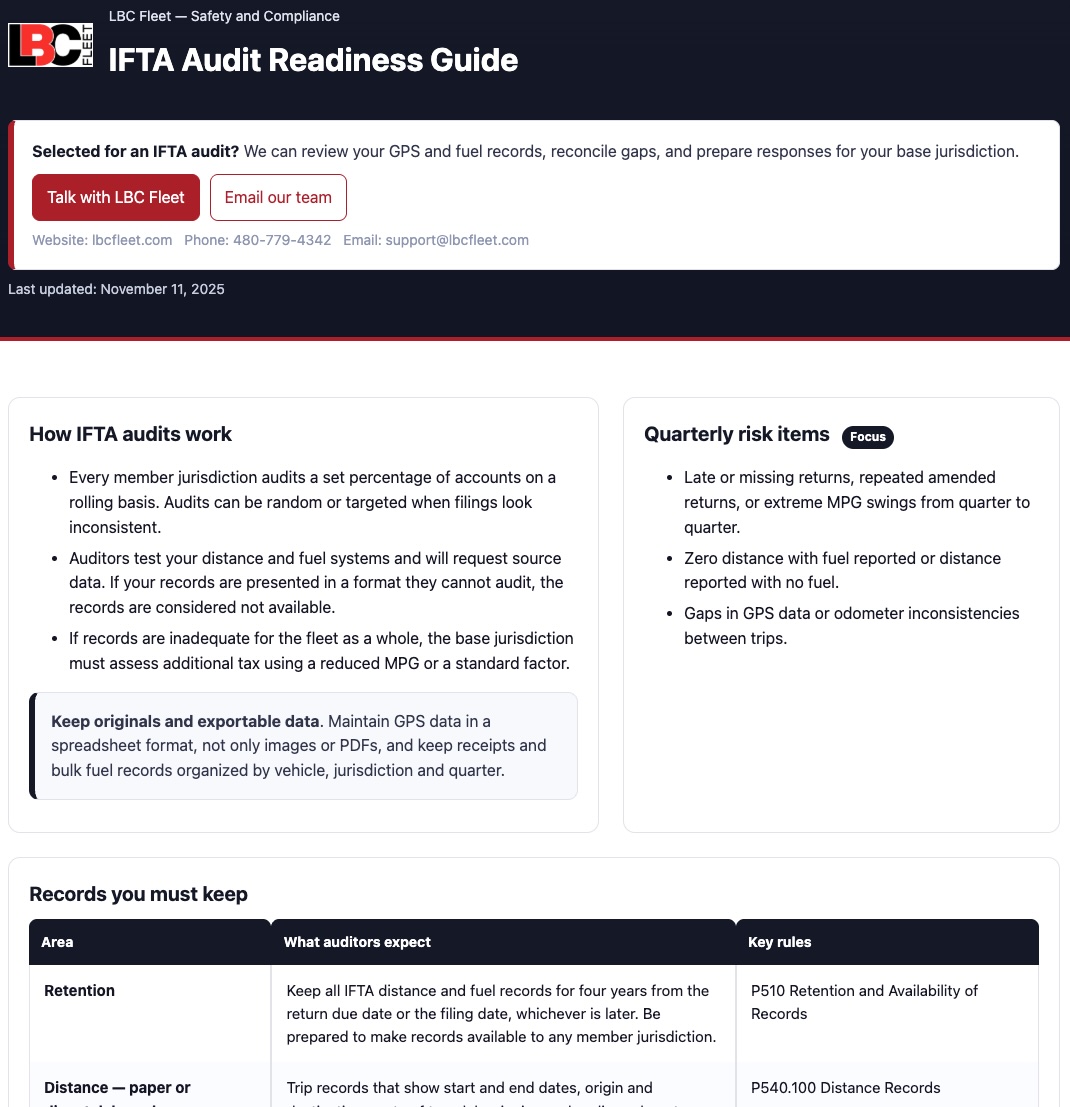
IFTA Audit Readiness Guide
Complete reference covering audit triggers, record requirements, GPS data formats, penalty calculations, and preparation checklists. With direct links to IFTA procedures.
Why Fleets Choose LBC Fleet for IFTA Audit Preparation
IFTA audits don't fail because the tax is wrong. They fail because the records don't add up — distance that doesn't match fuel, GPS pings outside the 10-minute window, bulk fuel logs that don't reconcile to receipts, summaries that don't tie to returns.
We've watched the same documentation gaps trigger the same assessments across thousands of audits. Our prep work is built around catching those gaps before the auditor does.
- 3,000+ real DOT audits since 2015 — the audit experience that informs our IFTA prep method.
- 99.8% satisfactory outcomes across the audit work we represent.
- P540 distance + P550 fuel reconciliation — every GPS point, every receipt, every variance documented.
- Mock audit included — we run sampling and projection so risks surface before the real audit. See mock DOT audit services.
- Aligned with your filing records — IFTA filing services, IRP, and DQ files all tell one consistent story under audit.
What "audit-ready" actually means
Most carriers think audit-ready means "we have records." Auditors mean something more specific: distance records that reconstruct any single trip, fuel records that match those trips line by line, quarterly returns that match the underlying summaries, and a story that holds when the auditor samples six months of data and projects across four years.
Our prep gets you to that bar. Records reconciled before the auditor walks in. Variances documented. Sampling tested. Representation ready.

What records IFTA audits require
IFTA audits hinge on two procedure standards from the IFTA Procedures Manual: P540 covers distance records, P550 covers fuel records. Both have specific requirements that auditors verify.
P540 distance records
- GPS or ELD data captured at intervals of 10 minutes or less when the engine is on
- Latitude/longitude coordinates with date and time stamps
- Beginning and ending odometer or ECM readings
- Distance recorded by jurisdiction
- Vehicle/unit ID matching every trip
P550 fuel records
- Retail receipts or accepted digital copies for every fuel purchase
- Date, seller name and location, gallons or liters, fuel type, price
- Vehicle/unit ID matching the distance records
- Bulk fuel logs with withdrawal records by vehicle and date
Retention: All distance and fuel records must be kept for at least four years from the return due date or filing date, whichever is later.
How to prepare for an IFTA audit
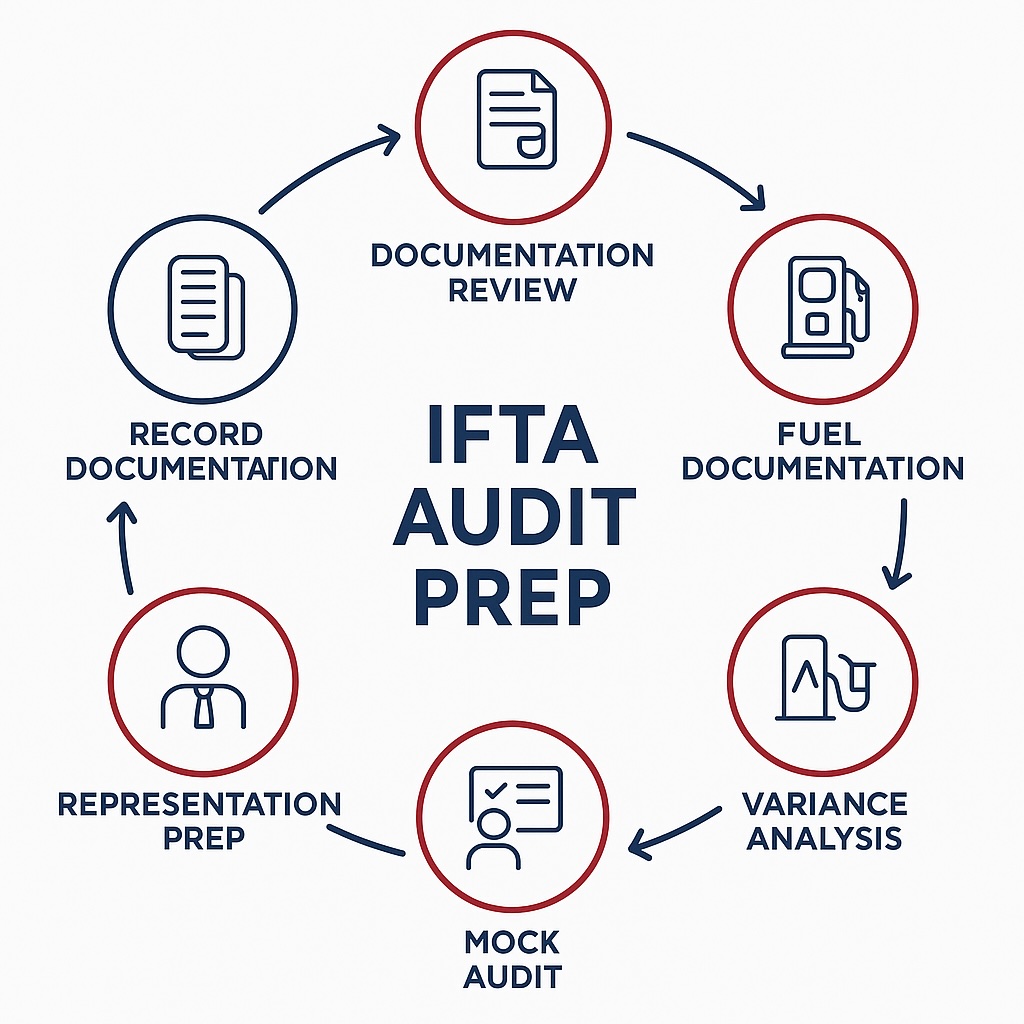
- Documentation review — verify GPS/ELD data meets the 10-minute P540 requirement with proper lat-long coordinates and ECM readings.
- Record reconciliation — align quarterly returns with monthly summaries and trip-level records.
- Fuel documentation — compile retail receipts and bulk fuel logs that satisfy P550 requirements.
- Variance analysis — identify and explain any MPG fluctuations or unusual patterns before they become an auditor question.
- Mock audit — run a practice audit with sampling and projection to surface risks early. See mock DOT audit services.
- Representation prep — prepare responses to common auditor questions and objections; attend the opening conference together.
Audit prep, or full IFTA filing service?
If you've received an audit notice and your filings are already current, IFTA audit preparation is what you need — we focus on documentation review, P540/P550 reconciliation, variance analysis, and representation through the audit close.
If you also want LBC handling the quarterly filing itself going forward — so the next audit doesn't sneak up on you — see our IFTA filing services. Many carriers come to us for audit prep and stay on for filing once the audit closes; the records discipline that survives an audit is the same discipline that prevents the next one.
What each service covers
IFTA audit preparation (this page)
- Documentation review against P540 and P550
- GPS data validation
- Variance analysis + sampling projection
- Mock audit + representation prep
- Auditor information request response
IFTA filing services (broader, ongoing)
- Licensing, decals, base jurisdiction setup
- Quarterly returns reconciled before filing
- Back-quarter cleanup
- Audit prep included when needed
IFTA audit resources
Federal IFTA authority
- IFTA Inc. — the agreement's administering body
- IFTA Procedures Manual (2024) — P540 distance, P550 fuel
- IFTA Articles of Agreement (2024) — penalties + assessments
- IFTA Audit Manual (2022) — selection + audit process
- Current IFTA interest rates (updated annually)
- 49 CFR Parts 300–399 — motor carrier regulations
- FMCSA — federal motor carrier safety oversight
LBC Fleet resources
- IFTA Audit Readiness Guide — downloadable
- IFTA filing services — ongoing quarterly filing
- Mock DOT audit services — proactive audit work
- DOT audit preparation services — broader DOT audit response
- DOT Compliance Resource Hub — full resource catalog
State-specific guidance
For other state-specific IFTA guidance, contact your base jurisdiction office directly — rules vary on grace periods, payment timing, and audit scheduling.
Be audit-ready before the letter arrives
We build a clean audit package — distance reconciled, fuel documented, summaries aligned to returns — with expert representation throughout the audit close.
Or call (480) 779-4342
IFTA audit preparation FAQ
How often do IFTA audits happen?
Every base jurisdiction must complete audits averaging 3% of IFTA accounts annually, with set portions of low-distance and high-distance accounts. Any licensee may be selected.
How much notice will I get before an audit?
Auditors typically contact you about 30 days before the audit to outline the period and records they will review.
What records must I keep to pass an IFTA audit?
Keep distance and fuel records that meet IFTA Procedures P540 and P550, including GPS/ELD data at least every 10 minutes when the engine is on, plus retail receipts or accepted digital copies and bulk fuel logs.
How long must I retain IFTA records?
Retain all IFTA distance and fuel records for four years from the return due date or filing date, whichever is later.
What happens if my records are inadequate?
The base jurisdiction must apply an inadequate-records assessment. This can set fleet MPG to 4.00 or reduce reported MPG by 20%, and may disallow tax-paid credits without proper documentation.
What penalties apply for late filing or payment?
The IFTA Articles set a $50 or 10% penalty, whichever is greater, with interest charged monthly at an annually set IFTA rate. Jurisdictions publish the rate each year.
Want IFTA audit prep off your plate?
We handle documentation review, GPS validation, mock audit, and representation. Records ready before the auditor opens them.