
Reactive Audit Response · Notice in Hand
DOT Audit Preparation Services
The audit notice arrived and the clock started. Our DOT audit preparation services help motor carriers respond when FMCSA has already scheduled a compliance review or safety audit — we assemble the digital packet, fix the gaps, and coach your team in 24 to 48 hours.
Same-day response nationwide. We start with a 15-minute triage call to map your timeline, then move straight into packet assembly.

DOT audit preparation services vs. mock DOT audits — what's the difference?
Mock audits are about finding surprises before FMCSA does. DOT audit preparation is about what happens after you've run out of time to find them. If the notice has already arrived, you're on the right page. If you haven't been notified yet, our mock DOT audit services are the better starting point.
Who DOT audit preparation services are for
If one of these describes your situation today, this page is the right starting point.
Notice in hand
"We got the audit notice and the clock is running"
FMCSA emailed or mailed the notice. You have a date. You don't have a packet. We move from triage call to digital packet in 24 to 48 hours.
New entrant
"We're approaching our 18-month safety audit"
New USDOT carriers face a mandatory safety audit in their first 18 months. The pass/fail standard differs from a compliance review — start at new entrant safety audit preparation.
Post-audit recovery
"We failed and have a Conditional or Unsatisfactory rating"
The corrective action window is 45 to 60 days — and since the 2026 Montgomery ruling, brokers actively screen Conditional ratings, so freight dries up fast. We build the CAP and route through DOT safety rating upgrade to restore Satisfactory. More on conditional rating and broker vetting.
On this page
Crisis mode? Jump straight to the section you need.
Self-serve tools
Free DOT compliance tools
- LBC Fleet DQ File Checklist — interactive walkthrough of what auditors check first. Open the checklist
- FMCSA Downgrade Rubric — the specific violations that move you from Satisfactory to Conditional or Unsatisfactory. Open the rubric
- Acute/Critical Violations Checklist — the violation categories that auto-fail an audit. Open the checklist
Why carriers choose LBC Fleet for DOT audit preparation services
- Real audit experience. 3,000+ real DOT audits since 2015 across passenger and property carriers, all 50 states.
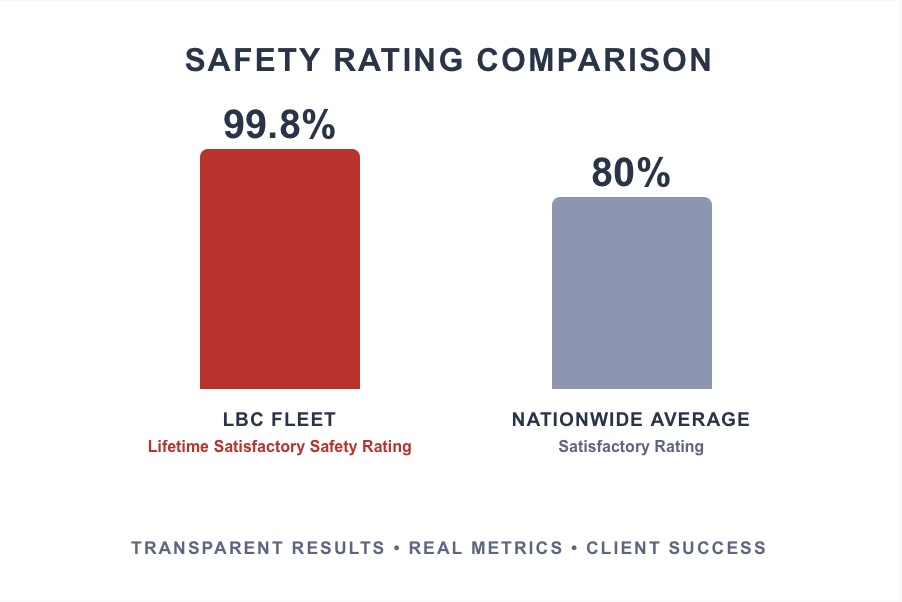
- The pass rate. 99.8% satisfactory outcomes. The number is the number.
- Speed when you need it. Digital packets ready for FMCSA portal upload in 24 to 48 hours — not a binder, not a PDF dump.
- Coaching before audit day. Personnel preparation and response scripting so your team isn't winging the interview.
- Coverage. Remote preparation is the default; onsite when the audit requires it.
What triggers a DOT audit or FMCSA compliance review
Already received your notice? Skip to the 6-step preparation process below. The triggers here are useful background but won't change what you need to do this week.
FMCSA uses multiple data points to select carriers for compliance reviews and safety investigations:
- High CSA percentiles in crash, driver-behavior, or vehicle-maintenance categories
- Serious crashes involving injuries, fatalities, or hazmat incidents
- Roadside violations resulting in out-of-service orders or repeat violations
- Safety complaints from drivers, competitors, or the public
- New entrant status — mandatory audit within the first 18 months
- Random selection for ongoing monitoring and enforcement
Compliance reviews examine six areas: driver qualification, drug and alcohol testing, hours of service, vehicle maintenance, accident reporting, and safety management controls. To monitor trigger risk between audits, see CSA score monitoring. For a step-by-step look at the review itself, see what happens in a DOT audit.

Complete FMCSA compliance review coverage
Our DOT audit preparation services produce digital packets covering every regulatory area auditors examine. Each document is indexed, properly formatted, and ready for immediate portal upload.
Driver Qualification Files (Part 391)
Complete files per 49 CFR 391.51: applications, employment verification, prior-employer background checks, MVR monitoring, medical certificates, CDL copies, road tests, and annual reviews. For ongoing help, see outsourced DQ file management.
Drug & Alcohol Testing (Part 382)
Pre-employment, random, post-accident, reasonable-suspicion, return-to-duty, and follow-up records, plus supervisor reasonable-suspicion training certificates per 382.603. Need help with DOT drug testing services?
Hours of Service (Part 395)
ELD data exports in auditor-required formats, supporting documents, exception documentation, and retention compliance per Part 395. Ongoing ELD and HOS management lives in our DOT compliance automation software. Passenger carriers can also use our Bus Hours of Service & ELD Support page to match trip facts, time records, and the questions an audit can raise.
Vehicle Maintenance (Part 396)
Systematic maintenance records with inspection schedules, completed DVIRs with correction documentation, annual inspection certificates, and repair invoices. Background reading: DVIR rule changes for passenger carriers.
Accident Reporting (Part 390)
Three-year accident register with all required fields per 390.15: date, time, location, driver and vehicle details, fatalities, injuries, and testing results.
Safety Management Controls
Written policies with annual updates, training acknowledgments, safety-meeting documentation, corrective action plans, and digital evidence of systematic safety management.
The LBC Fleet DOT audit preparation process
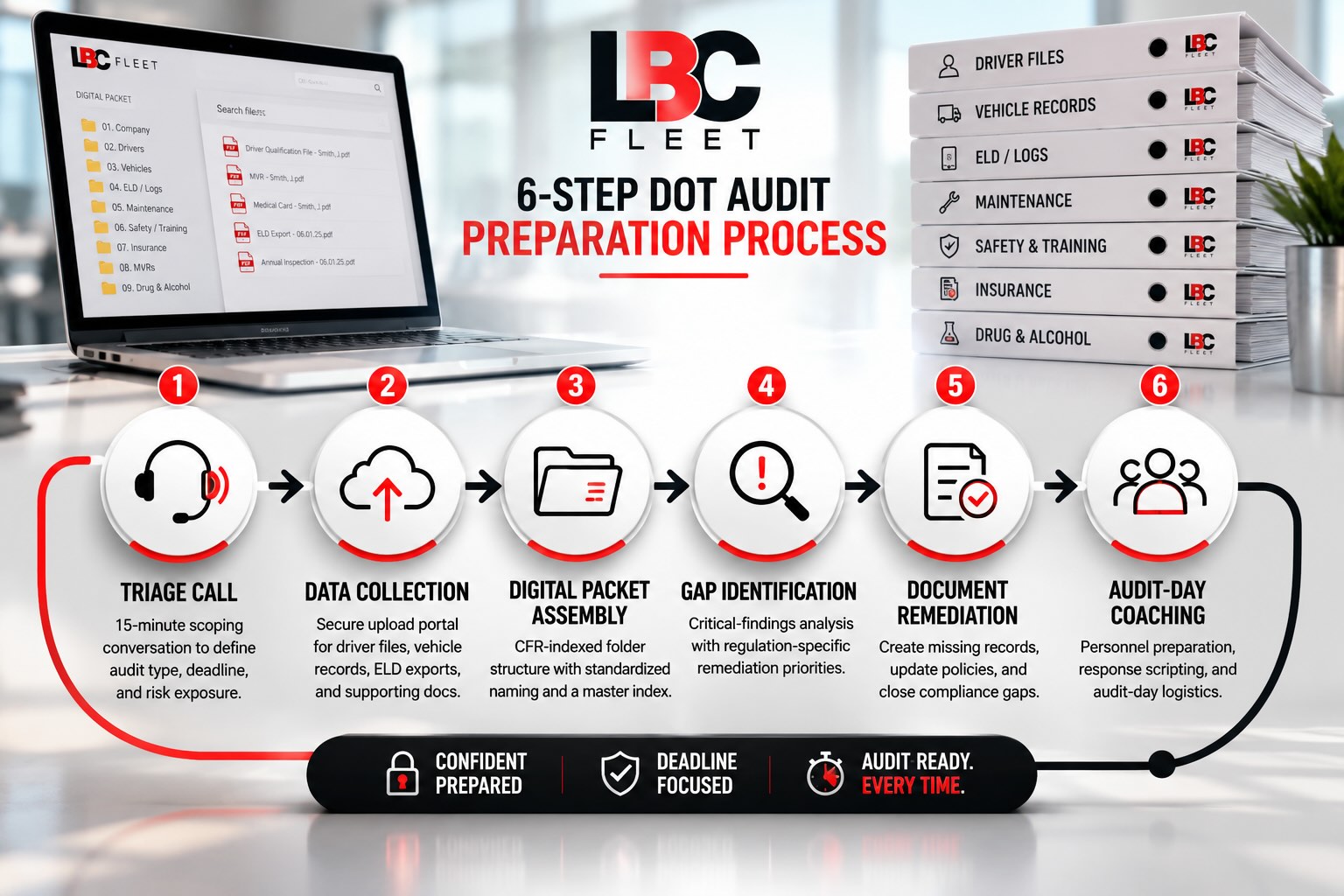
Our DOT audit preparation services follow a systematic 6-step approach built for carriers under deadline pressure.
- Triage call: 15-minute scoping conversation — audit type, deadline, risk exposure.
- Data collection: secure upload portal for driver files, vehicle records, ELD exports, and supporting documentation.
- Digital packet assembly: CFR-indexed folder structure with standardized file naming and a master index.
- Gap identification: critical-findings analysis with regulation-specific remediation priorities.
- Document remediation: missing-record creation, policy updates, and compliance templates. Most DQ gaps trace to missing employment verifications, expired medical certs, or missed annual MVRs — see our DQ file audit guide.
- Audit-day coaching: personnel preparation, response scripting, and audit-day logistics.
Available nationwide: remote preparation for immediate response, or onsite when travel is required.
What's in a clean audit packet
Critical documents auditors examine
- Company documentation: MCS-150 updates, operating authority certificates, insurance documentation.
- Driver qualification files: complete 391.51 compliance for every driver.
- Drug & alcohol program: records for all six test types, written policy, Clearinghouse queries, supervisor reasonable-suspicion training certificates per 382.603.
- Hours of service: ELD raw-data exports, supporting documents, exception memos, HOS policy.
- Vehicle documentation: current registrations, insurance certificates, annual inspection records.
- Maintenance program: DVIR documentation, preventive maintenance schedules, repair invoices.
Comprehensive compliance documentation
- Accident register: three-year register with all 390.15 required fields.
- Safety policies: written HOS, drug and alcohol, maintenance, incident-reporting, mobile-phone, and seat-belt policies.
- Training documentation: policy acknowledgments, safety meetings, corrective actions.
We deliver a complete digital audit packet with organized folder hierarchy, standardized file naming, and a comprehensive index mapped to CFR requirements.
We assemble your digital audit packet, fix gaps, and coach your team so you pass with confidence. Already audited and the rating came in below Satisfactory? We also handle corrective action plans and rating upgrades.
DOT audit preparation FAQ
Can you prepare audit documentation in 24 to 48 hours?
Yes. Our response system allows same-day document collection and digital packet assembly within 24 to 48 hours. We maintain secure upload portals and can coordinate rapid document preparation when audits require immediate response.
Do supervisors need Reasonable Suspicion Training certificates?
Yes. Per 49 CFR 382.603, supervisors of drivers who operate CDL vehicles must receive at least 60 minutes of training on alcohol misuse and 60 minutes on controlled-substances use. We verify each supervisor's certificate is current and properly documented.
What happens if we fail a DOT audit?
Failed audits result in Conditional or Unsatisfactory safety ratings, and you'll have 45 to 60 days to submit a corrective action plan. An Unsatisfactory rating can lead to out-of-service orders. Since the 2026 Montgomery ruling, brokers also screen Conditional ratings and route freight elsewhere, so restoring Satisfactory protects your revenue as well as your authority. We help carriers avoid failure through proper preparation and provide post-audit help through our DOT safety rating upgrade service if needed.
How much does a failed DOT audit cost?
Failed audits can cost $5,000 to $30,000 or more in fines, plus lost revenue from Conditional or Unsatisfactory ratings affecting insurance rates and customer contracts. Audit preparation typically costs far less than a single violation and helps avoid these consequences.
What file formats do FMCSA auditors require?
Auditors accept PDF for static records, CSV or Excel exports for ELD and HOS data, and comprehensive index files mapping every document to specific regulatory requirements. We format all documents according to current FMCSA portal specifications.
Can you travel onsite for audit preparation?
Yes. We provide nationwide travel for onsite audit preparation when circumstances require physical presence. Most preparation can be completed remotely through our secure digital systems, but we coordinate onsite assistance when needed.
What is the difference between a Safety Audit and a Compliance Review?
Safety Audits are conducted for new entrants within 18 months of USDOT number assignment. Compliance Reviews are comprehensive investigations under Part 385 that result in safety ratings: Satisfactory, Conditional, or Unsatisfactory.
Do you offer corrective action plan assistance?
Yes. If you've already undergone an audit and received violations, we help develop comprehensive corrective action plans that address each acute and critical violation with specific timelines and implementation strategies to restore satisfactory compliance status.
For ongoing prevention between audits, browse the DOT compliance resource hub.
Related resources
Rating came in low
DOT safety rating upgrade
Corrective action plans that move Conditional or Unsatisfactory back to Satisfactory.
Losing loads
Conditional rating and broker vetting
Why brokers now screen conditional carriers — and how to get the freight back.
Renewal coming up
Fleet insurance renewal preparation
Get your records organized before a renewal, a market shop, or an insurer’s audit request.