Brokers Won’t Work With Your Conditional Rating? Here’s How to Get Your Loads Back
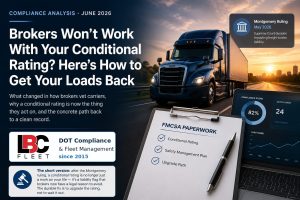
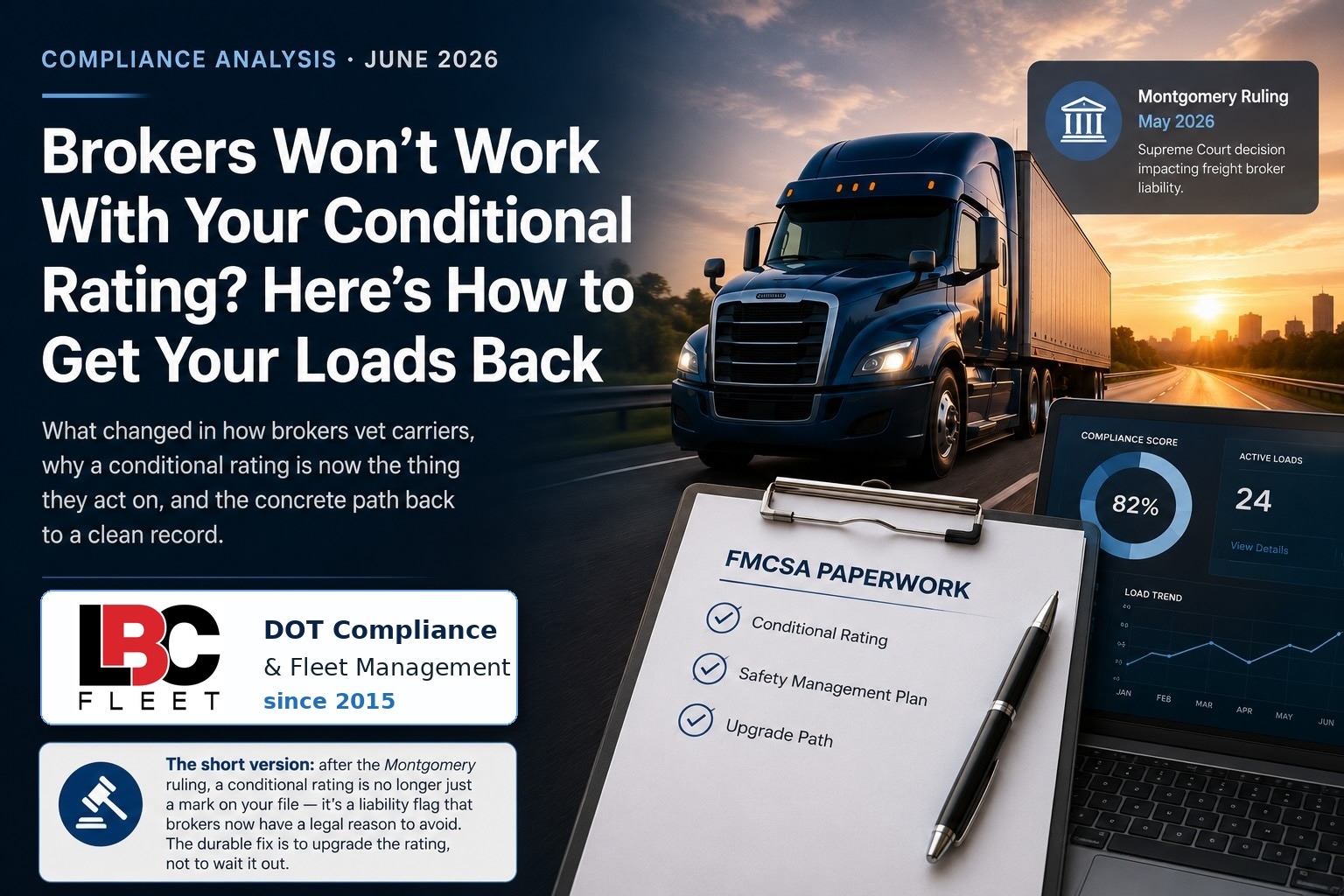
If your freight slowed down after a downgrade and you figured it was just the market, it probably wasn’t. Here’s what changed in how brokers vet carriers, why a conditional rating is now the thing they act on, and the concrete path back to a clean record.
LBC Fleet · DOT Compliance & Fleet Management since 2015
You may have seen the headlines: in May 2026 the Supreme Court ruled that freight brokers can be sued when they hire an unsafe carrier. The coverage framed it as a broker problem — a warning to the big middlemen, a win for crash victims. That’s all true. The part the headlines skipped is what it means for you, the carrier with a conditional rating sitting on your record right now.
The short version: after the Montgomery ruling, a conditional rating is no longer just a mark on your file — it’s a liability flag that brokers now have a legal reason to avoid. The durable fix is to upgrade the rating, not to wait it out.
What this covers
Why brokers back away
What brokers actually see
Why waiting costs more
How to get loads again
FAQ
Why brokers won’t work with a conditional rating anymore
Brokers avoid conditional-rated carriers because, after the 2026 Supreme Court ruling in Montgomery v. Caribe Transport, hiring a carrier with a poor safety rating can expose the broker to a negligent-hiring lawsuit.
Here is what happened. On May 14, 2026, the Supreme Court ruled 9–0 that a freight broker can be sued under state negligence law for hiring an unsafe motor carrier. The case involved a broker that dispatched a carrier which had a conditional safety rating at the time. A driver for that carrier caused a crash that severely injured someone, and the court allowed the injured party’s claim against the broker to move forward — ruling that the broker could be held responsible for putting a carrier with that safety record on the road.
For years, brokers were largely shielded from these lawsuits by a federal law. That shield is now gone for safety-based claims. So a broker looking at your record is no longer just asking “can this carrier move my freight?” They are asking “if this carrier crashes, can I be sued for choosing them?” A conditional rating is the exact fact pattern that created the liability in Montgomery — which is why a rating you might have lived with two years ago can quietly cut off your load board today.
None of this means you are a bad operator. A single failed factor on one compliance review can produce a conditional rating. But brokers under new legal pressure are not weighing the nuance — they are screening the rating.
Full breakdown
We unpack the decision and what it changes for carriers in our explainer on the Supreme Court’s broker-liability ruling. You can also read the opinion itself at Cornell’s Legal Information Institute.
↑ Back to top
Do brokers actually check your safety rating?
Yes — your safety rating and inspection history are public, and brokers and shippers pull them before they book you.
Your rating isn’t hidden inside an FMCSA filing cabinet. Anyone can look up your company on the FMCSA SAFER Company Snapshot and see your safety rating in seconds. Brokers’ carrier-vetting software does this automatically — it pulls your rating, your authority status, your insurance, and your roadside inspection trends, and flags anything that looks risky.
A conditional rating is the loudest flag on that list. Underneath it, brokers also see your CSA scores — the percentile rankings FMCSA assigns across categories like unsafe driving, hours-of-service compliance, vehicle maintenance, and driver fitness. High percentiles in those categories reinforce the same story the conditional rating tells: this carrier’s safety controls slipped somewhere. After Montgomery, that story is exactly what a broker’s lawyer would point to if a crash ever landed in court.
The practical takeaway: assume every broker you approach already knows your rating before they pick up the phone. Keeping an eye on the same data they see — through CSA score monitoring — lets you fix the trends that feed a downgrade before they cost you another load.
Why waiting it out is the expensive option
A conditional rating does not expire on its own, and there is no deadline forcing FMCSA to review it — so “waiting” usually means months of lost freight, higher insurance, and harder financing with no end date.
Carriers often assume a conditional rating clears itself once enough time passes. It doesn’t. Under 49 CFR 385.17, FMCSA only faces a review clock for Unsatisfactory ratings. For a Conditional rating, the rule sets no deadline at all — the rating stays exactly where it is until you take action to change it. Sitting still is a decision to keep the rating.
And the rating costs you the whole time it sits there:
- Brokers and shippers restrict or refuse you, so your freight volume and your rates both drop.
- Insurance premiums climb — carriers commonly see double-digit percentage increases tied to a conditional rating.
- Factoring companies may charge more or decline accounts, squeezing your cash flow.
- Many large-shipper and government contracts exclude conditional-rated carriers outright.
Every month spent waiting is a month paying all of those costs. Acting on the rating is almost always cheaper than living with it.
How to get loads with a conditional rating again
The reliable way to get loads with a conditional rating is to upgrade the rating — file a corrective action request with FMCSA under 49 CFR 385.17, backed by real evidence that you’ve fixed the deficiencies behind the downgrade.
There are two formal ways to change a rating. If you believe FMCSA made an error in the review, you can request an administrative review. The more common path is a corrective-action change: you fix the specific problems the investigator cited, document the fixes, and submit a written request with a Safety Management Plan proving your controls now meet the federal standard. FMCSA reviews the package and, if the evidence holds up, upgrades your rating.
The piece carriers get wrong is the word evidence. Telling FMCSA “we fixed it” without proof is the single most common reason an upgrade request gets denied. A request that works maps each violation to the regulation it broke, shows the corrected policy, and includes records — DQ files, maintenance logs, hours-of-service controls, testing records — that demonstrate the fix is real and sustained.
This is the work LBC Fleet does. Our DOT safety rating upgrade service builds the corrective action plan and evidence packet, files it to the correct FMCSA office, and then keeps pushing until an analyst actually reviews it and rules — instead of submitting a document and disappearing. It’s the same workflow that comes out of having run thousands of real DOT audits since 2015, so we know what an investigator needs to see.
If you’d rather get ahead of a downgrade than recover from one, a proactive mock DOT audit finds the deficiencies that cause a conditional rating before an FMCSA investigator does.
Already past conditional? If you have a proposed Unsatisfactory rating, the clock is real — the rating becomes final in 45 or 60 days and an operations shutdown follows. Don’t wait. Start with the DOT safety rating upgrade process today.
In your first 18 months? New carriers follow a different track — see new entrant safety audit preparation.
↑ Back to top
Conditional rating and brokers: common questions
Can I get loads with a conditional safety rating?
Yes, you can legally operate and haul freight with a conditional rating. But many brokers and shippers now restrict or avoid conditional-rated carriers because of broker-liability risk, so expect fewer load offers, lower rates, and higher insurance until you upgrade the rating.
Why won’t brokers work with me after a conditional rating?
After the May 2026 Supreme Court ruling in Montgomery v. Caribe Transport, brokers can be sued for negligent hiring if they dispatch an unsafe carrier. A conditional rating is the kind of safety flag that created liability in that case, so risk-averse brokers screen it out to protect themselves.
A broker said I need a satisfactory rating — is that normal now?
Increasingly, yes. Many brokers and larger shippers have always preferred satisfactory-rated carriers, and after the broker-liability ruling more of them are making it a hard requirement. The fix is to pursue a rating upgrade so you can meet that requirement rather than lose the freight.
How long does a conditional rating last?
Indefinitely, until you act. FMCSA has no deadline to review a conditional rating, so it stays on your record until you file a successful corrective action request to change it. It does not clear on its own with time.
How do I get my rating back to satisfactory?
You file a corrective action request under 49 CFR 385.17: fix the cited deficiencies, document the fixes with real evidence, submit a Safety Management Plan to the correct FMCSA office, and follow up until it’s reviewed. Most carriers use a compliance specialist to build the evidence packet that gets approved.