Automate the record chase without giving up operational judgment
Vendors sell it as compliance, handled. What it actually handles is recordkeeping. That distinction decides whether the purchase works or becomes one more system nobody updates.
LBC Fleet · DOT compliance and fleet management since 2015
Compliance software is very good at one category of failure and useless against another. It eliminates the failure where nobody knew a medical certificate expired. It does nothing about the failure where everybody knew and nobody followed up. Almost every DQ file problem we see in a real audit is the second kind, which is worth sitting with before you evaluate a single platform. It is the same pattern behind how driver qualification files get managed day to day.
There is a second problem, and it quietly costs fleets more money than the first one. Most buyers do not know what is available in a compliance platform. They come looking for driver files, find driver files, and never learn that vehicle inspections, hours of service, GPS, and maintenance can run in the same system. So they go buy those from three other vendors, and end up paying four companies to each hold one piece of the same fleet.
In this article
What it does
What it automates
What can live in one platform
What it does not do
Software, service, or both
How to evaluate one
FAQ
What does DOT compliance software do?
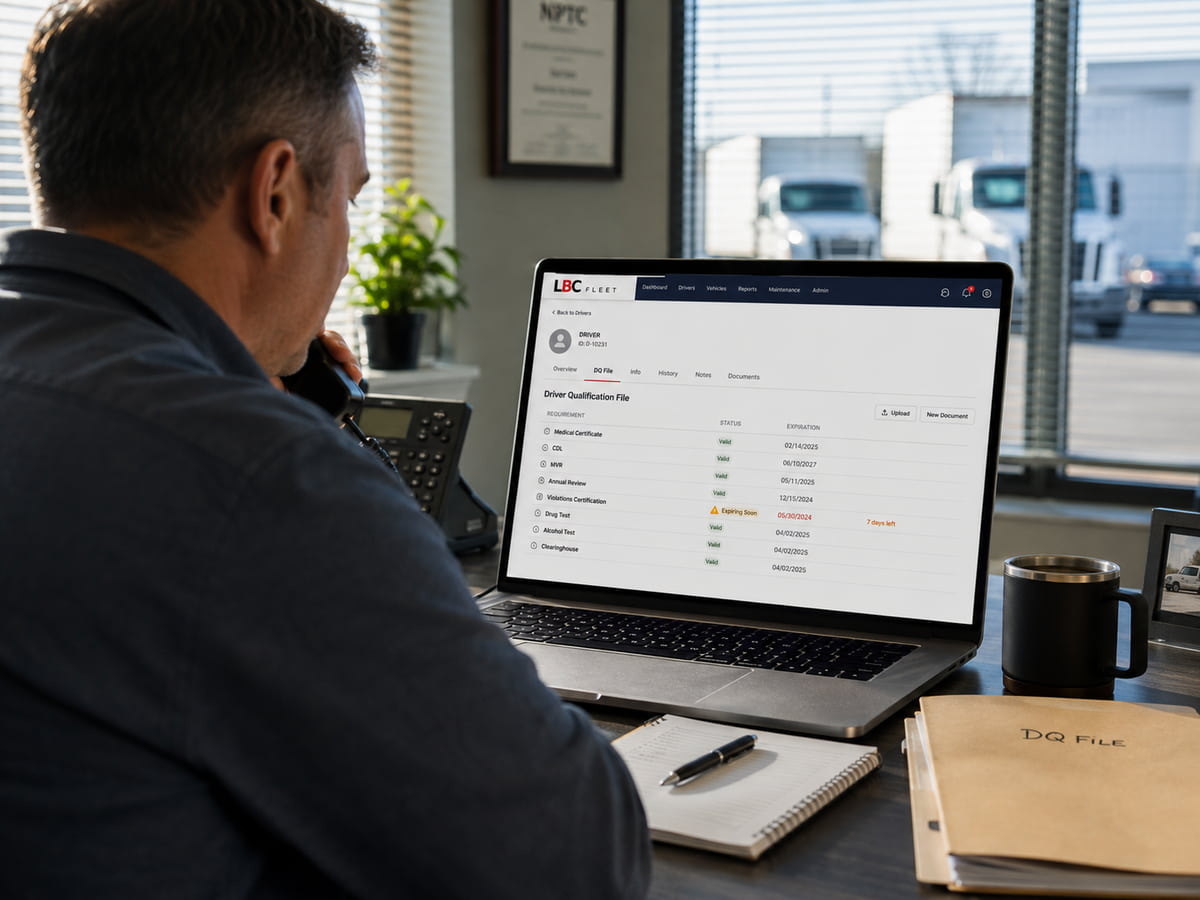
DOT compliance software tracks regulated records and their expiration dates, stores the underlying documents, warns you before something lapses, and produces the file set an auditor asks for. Everything else a platform offers is built on top of those four functions.
The regulations decide the scope. 49 CFR 391.51 lists what has to live in a driver qualification file and how long each item has to stay there. Other parts govern hours of service, vehicle inspection records, and drug and alcohol testing. Compliance software is simply the system that holds those obligations as data instead of as things people remember.
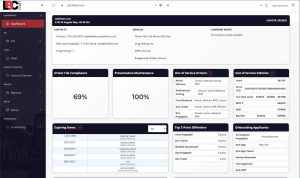
Framed that way the value is unglamorous and real. A fleet running on spreadsheets and a file cabinet is not out of compliance because anyone is careless. It is out of compliance because the information about what is due lives in three places and none of them raise a hand. DOT compliance automation software makes the due date the system’s job rather than a person’s memory.
What compliance software actually automates
Six jobs: expiration tracking, document capture, escalating reminders, ordering the underlying records, audit-ready export, and the proof trail that shows the process ran. How many of those a platform genuinely does is the difference between software and a filing cabinet that sends email.
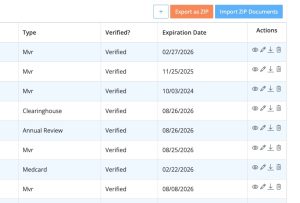
Tracking is the obvious one. Medical certificates, licenses, annual MVR reviews, annual certifications of violations, random pool status. Every regulated item carries a date, and once the dates are in a system the system can build the queue instead of a person rebuilding it every Monday. Underneath that sits document capture, which matters more than it sounds. You want the current medical card and the three before it, each stamped with when it arrived and who accepted it, because auditors ask about history and not only about today.
Reminders are where most platforms quietly fail. A notice that emails one person is not a reminder, it is a single point of failure that works until that person takes a week off. Escalation is the feature that matters: the driver hears about it, then the supervisor, then whoever actually owns compliance, on a schedule that assumes people are busy rather than assuming they are not.
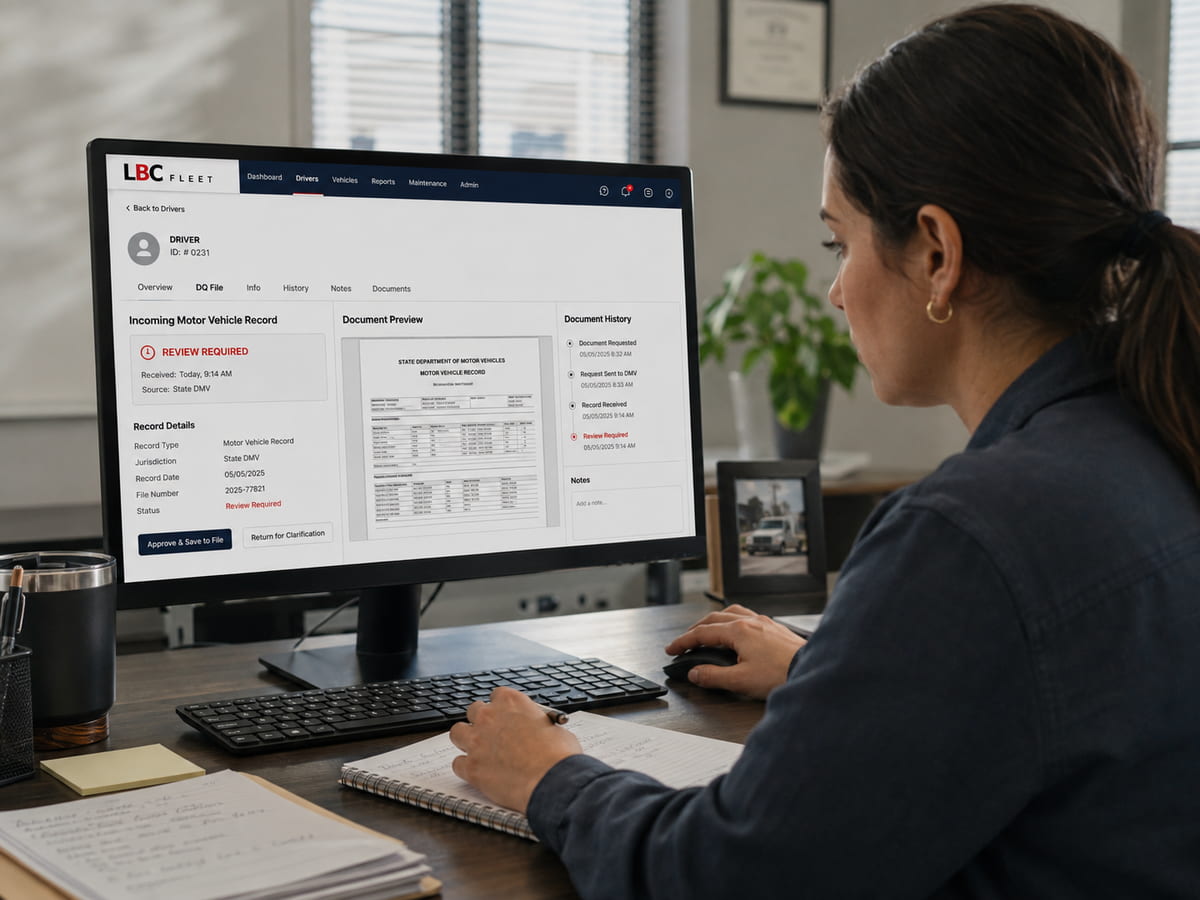
The fourth job is the one most platforms skip entirely, and it is the difference between a system that stores your work and a system that does some of it. Storing an MVR is easy. Getting the MVR is the slow part. In our platform, MVRs, background checks, and drug and alcohol testing are ordered inside the same system that holds the file, so the result comes back attached to the driver record rather than landing in somebody’s inbox and waiting for a manual upload that may or may not happen this week.
There is a deliberate limit on that automation. Results arrive ready for review and approval, not filed silently. Somebody still reads the MVR before it becomes part of the qualification file, because compliance needs more than one set of eyes. The point of automation is to remove the retyping, not the judgment, and a platform that quietly accepts records on your behalf has removed the wrong thing.
The last two jobs only reveal their value under pressure. Audit-ready export means one driver, one complete file, ordered the way an investigator expects, produced in a minute instead of an afternoon. And the proof trail, the timestamps showing that the review happened and the notice went out and the document was accepted, is frequently what separates a finding from a note in the margin. Process evidence is worth more during an audit than most people expect, because it distinguishes a bad week from a bad system.
Related reading
How driver qualification files actually get managed across a fleet
Back to top
What can actually live in one platform
Driver records are one module. A full platform can also cover record ordering, hours of service, electronic vehicle inspections, GPS, maintenance and work orders, and fleet purchasing, all under one login with one vendor. Most fleets buy those separately because nobody ever told them they had a choice.
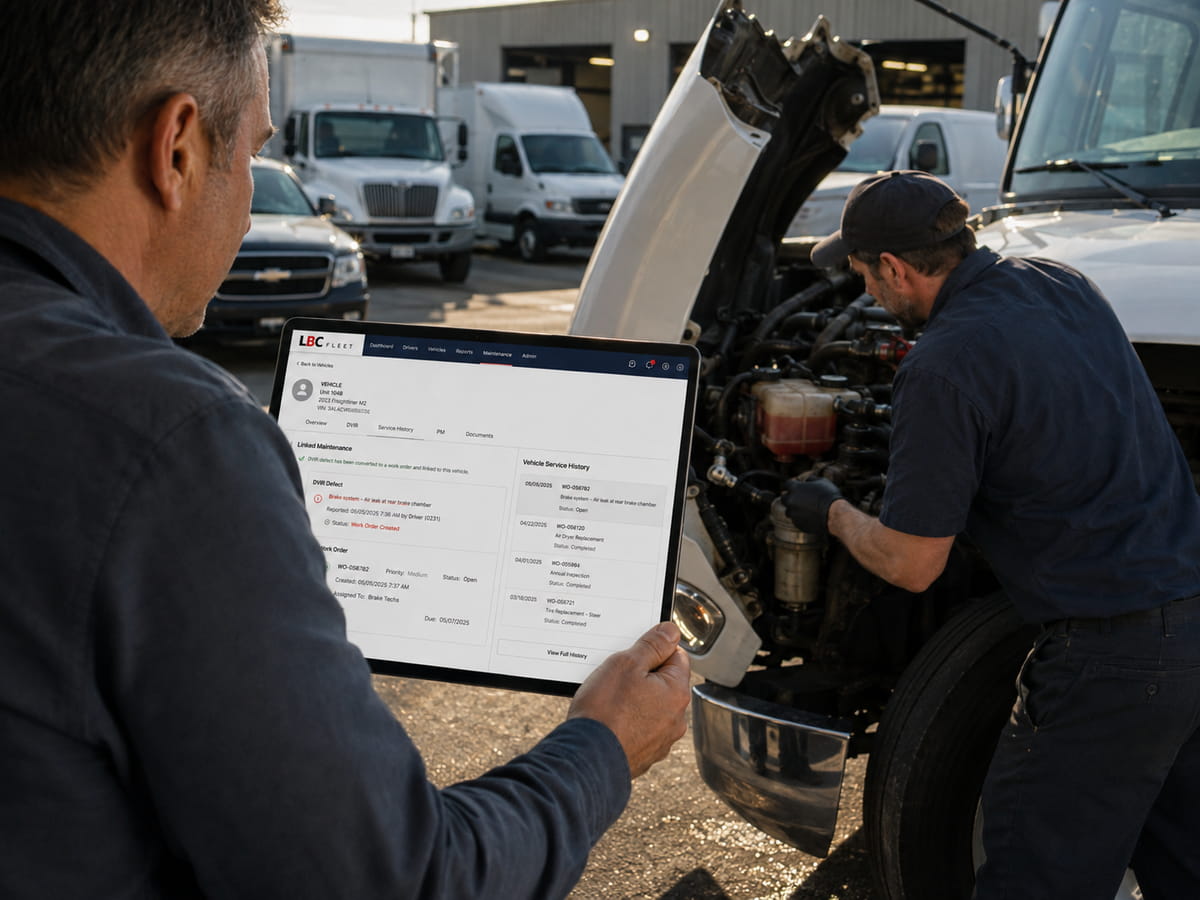
Here is what runs inside LBC Fleet Software today, and some of it will be news even to people who have used the platform for years, which is our failure and not the product’s. On the compliance side: driver qualification files, MVRs, background checks, and drug and alcohol testing including random pool management, all ordered and held in the same place. On the operations side: ELD and hours of service, electronic DVIRs, GPS tracking, and maintenance with work orders and service history against each unit. If you run passenger equipment, our Bus Hours of Service & ELD Support page shows the practical record trail behind the trip. And then the one nobody expects from a compliance company, fleet pricing on tires and service, which is the only item on the list that shows up as money saved rather than time saved.
The reason to care is not the length of that list. It is what happens in the gaps between the items. A roadside inspection result belongs to the vehicle file and to the driver’s record at the same time. A defect written up on a DVIR should turn into a work order without anyone retyping it. Hours of service problems and driver file problems tend to arrive in the same audit, from the same investigator, on the same day. When those things live in four systems, connecting them is somebody’s manual job, and manual jobs are exactly where compliance breaks. When they live in one, the connection is just how the data sits.
None of that requires buying everything at once. If driver files are genuinely the whole problem, electronic DQ file software is the narrow door. If you want the operations side too, that is fleet management software. It is the same platform underneath either way, so starting small does not mean rebuilding later, and adding a module later does not mean a migration.
Modules are priced individually and add-ons carry additional subscription charges. When comparing costs, it is worth adding up what you currently pay across separate ELD, GPS, and compliance vendors rather than comparing a single line item.
What compliance software does not do
Software can organize the work, but it does not replace the underlying DOT compliance requirements.
It does not chase the driver, make regulatory judgment calls, run your Clearinghouse queries, repair a broken hand-off, or represent you in an audit. Every one of those still belongs to a person, and a vendor who implies otherwise is selling you a feeling.
It does not chase the driver. The platform can send the notice eleven times and it still cannot walk out to the yard and ask for the new medical card. When a file goes bad, the alert almost always fired. Someone saw it, meant to handle it, and the week got away from them.
It does not make judgment calls either. A medical certificate can be perfectly valid on its face and still be a problem if the examiner is no longer listed on the National Registry of Certified Medical Examiners. An MVR can pass every rule the software knows and still contain something that changes how you should be using that driver. Software validates dates. People validate meaning, and the gap between those two things is where most real risk lives.
It does not run your Clearinghouse queries. Queries in the FMCSA Drug and Alcohol Clearinghouse are performed by a person with the right access and the driver’s consent on file. Our software does not integrate with the Clearinghouse, and any vendor telling you the query happens by itself is describing something other than the query. We handle it as a managed human process, because that is what it is.
And it does not fix a broken hand-off. If nobody owns follow-up, software will hand you a beautifully organized record of everything you failed to do on time. The tool makes the failure visible. It does not assign it an owner.
The useful test before you buy: ask who acts on the alert. If the answer is a specific person with the time to act, software will solve your problem. If the answer is unclear, software will document it.
Finally, it does not represent you in an audit. When an investigator has questions about a pattern in your records, a login does not answer them, which is why the next section is about people rather than features. If you already have a notice in hand the sequence changes entirely, and it helps to know what an investigator actually looks at once an audit starts.
Already have an audit notice
DOT audit preparation services
Back to top
Do you need software, a service, or both?
Software if you have a person who owns compliance and needs better tools. A managed service if you do not. Both if compliance keeps losing to operations every time the two compete for the same person’s afternoon.
Software alone works when someone in your office already owns driver files, knows the requirements, and simply lacks a system. Give that person expiration logic, document storage, and ordering in one place and they get sharply better almost immediately. The purchase pays for itself in hours recovered, and there is nothing else to solve.
A managed service alone works in the opposite situation, when nobody owns compliance and nobody is going to. Handing out the whole function means the follow-up, the judgment calls, and the Clearinghouse queries belong to someone whose entire job is that work rather than someone doing it between dispatch calls. Outsourced DQ file management is that arrangement.
Both is the common case for fleets that are growing. The platform holds the records and the operations data, and a compliance team works inside it, which means you can see exactly what is being done rather than receiving a monthly summary and hoping it reflects reality.
What to look for when you evaluate compliance software
Judge a platform on date logic, ordering, escalation, export format, version history, and how far it reaches beyond driver files. Demos are built to show dashboards. Audits test something else entirely, so it is worth walking into the demo with the questions already written down.
- Does it order records, or only store them? If MVRs, background checks, and testing are ordered somewhere else and uploaded by hand, you have bought a folder.
- Does approval sit between the result and the file? Records should arrive ready for review, not filed silently.
- Does escalation reach a second person? One inbox is a single point of failure wearing a feature name.
- Can it export one complete driver file? Ask to watch it happen live, not to see a screenshot.
- Does it keep superseded documents? History is often exactly what an investigator asks for.
- What else can it run, and what would that let you cancel? Compare against the total of your current subscriptions, not the line item in front of you.
It is worth running your own files against those questions before you shop at all. Our driver qualification file checklist workflow is a fast way to sort your current gaps into three piles: tracking problems, follow-up problems, and judgment problems. Only the first pile gets solved by buying anything, and knowing that before a demo will save you from being sold the wrong solution convincingly.
Frequently asked questions
What does DOT compliance software do that a spreadsheet cannot?
A spreadsheet holds dates but does not act on them, does not store the document behind the date, does not keep superseded versions, and cannot produce a complete driver file on demand. Compliance software turns a static list into a queue that raises its hand before something lapses.
Does compliance software keep you compliant?
No. It keeps you informed. Compliance happens when someone acts on what the system surfaces. Fleets that buy software and assign nobody to act on the alerts end up with well-documented violations.
Can compliance software order MVRs, background checks, and drug tests?
Some can. Ours does. MVRs, background checks, and drug and alcohol testing are ordered inside the platform and the results return attached to the driver record, held for review and approval before they become part of the qualification file. Many platforms only store what you upload yourself, which leaves the slowest step manual.
What else can run in the same platform as driver files?
In LBC Fleet Software: ELD and hours of service, electronic DVIRs, GPS tracking, maintenance and work orders, and fleet pricing on tires and service, alongside driver qualification files and record ordering. Each is a module you turn on when you need it.
Is everything in the platform included in one price?
No. Modules are priced individually and add-ons carry additional subscription charges. The value of one platform is a single vendor, a single login, and connected data across compliance and operations. When comparing costs, add up what you currently pay across separate ELD, GPS, and compliance vendors rather than comparing one line item.
Does compliance software connect to the FMCSA Clearinghouse?
LBC Fleet Software does not integrate with the Clearinghouse. Queries are run by a person with the appropriate access and the driver’s consent on file. We handle them as a managed service. Treat any claim of a fully automatic Clearinghouse query with caution.
What role does compliance software play during a DOT audit?
It shortens the retrieval phase and demonstrates process. Instead of assembling files under deadline, you export them. The timestamps also evidence that reviews and notices actually happened, which matters when an investigator is assessing whether a gap was an isolated lapse or a systemic one. See mock DOT audit services if you want that tested before the real thing.
Compliance, driver records, and fleet operations in one system, with people available when the work needs a second set of eyes. Fifteen minutes is enough to see what you may already be paying three vendors for.
Book an Intro Call
Explore the Compliance Platform
LBC Fleet has handled DOT compliance and fleet management for chauffeured transportation, motorcoach, trucking, and service fleets since 2015.